


In a decisive move to curb cyberbullying, online pedophilia, and algorithmic exploitation of minors, the Malaysian Government has announced an ambitious regulatory intervention: mandating a strict minimum age limit of 16 for users on social media and internet messaging services. Spearheaded by the Malaysian Communications and Multimedia Commission (MCMC), the policy couples child safety restrictions with a mandatory licensing framework for major digital platforms. For multinational technology providers and cloud services operating across Southeast Asia, this marks an unprecedented shift in ASEAN platform accountability.
The Regulatory Framework: MCMC Class Licensing and Youth Safeguards
Under the regulatory framework enacted pursuant to the Communications and Multimedia Act 1998, platforms exceeding 8 million registered Malaysian users must obtain an annual Class Licence to operate legally. The introduction of the 16+ age requirement introduces strict operational obligations:
- Mandatory Operational Licensing: Platforms failing to register or repeatedly non-compliant with child-protection guidelines risk severe statutory penalties, DNS-level regulatory measures, or operational suspension within Malaysia.
- Algorithmic & Safety Accountability: Licensed platforms are legally compelled to institute proactive moderation to suppress algorithmic harm, predatory exploitation, and financial scams targeting youth.
- Systemic Age Gating: Services must implement robust and verifiable verification processes to prevent minors under 16 from independently creating accounts or interacting in unmonitored digital forums.
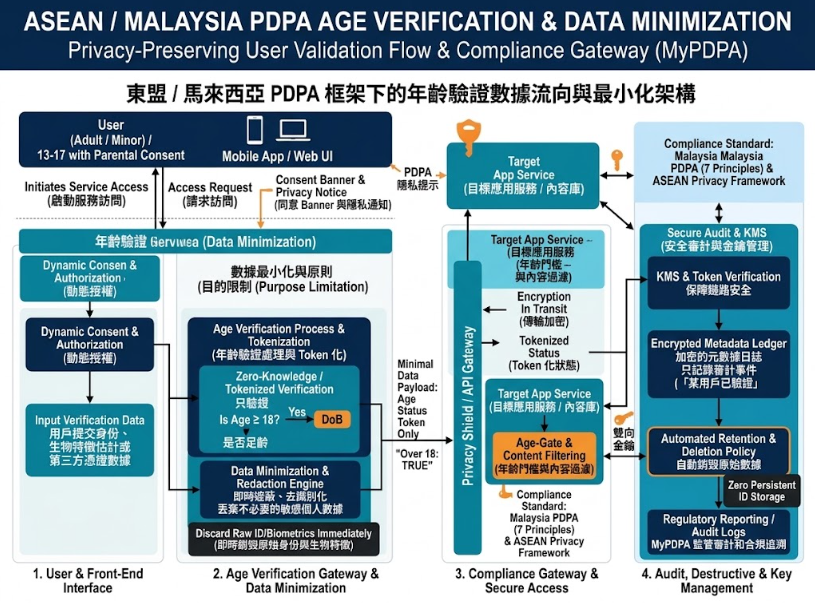
The Privacy Dilemma: Navigating Malaysia’s Reformed PDPA
While public sentiment broadly favors increased child online safety, Chief Information Security Officers (CISOs) and Data Protection Officers (DPOs) face substantial compliance hurdles under Malaysia’s amended Personal Data Protection Act (PDPA):
1. Parental Consent and Proof-of-Guardianship Friction
Under the revised PDPA, processing personal data of individuals categorized as minors necessitates verifiable parental consent. Platforms implementing digital verification workflows must design frictionless proof-of-guardianship mechanisms without needlessly collecting sensitive identification from parents.
2. Avoiding National ID and Biometric Honeypots
Demanding Malaysian National Registration Identity Cards (MyKad) or ingesting facial biometric telemetry to calculate age creates acute cybersecurity liabilities. Centralizing unencrypted identity records introduces severe risk under the PDPA's enhanced mandatory data breach notification requirements.
3. Cross-Border Data Transfer Scrutiny
Because major platforms process telemetry across regional data center hubs (e.g., Singapore, Australia, or the US), transmitting Malaysian minors' verification logs across borders requires adequate legal transfer mechanisms, robust contractual clauses, and localized data safeguards.
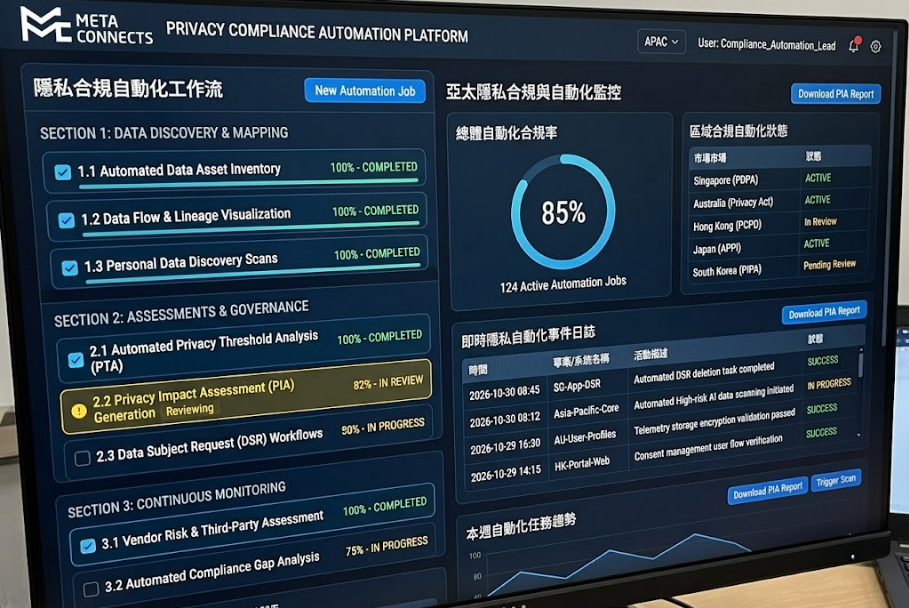
Strategic Blueprint: Recommended Actions for Digital Platforms
To address the dual demands of MCMC platform licensing and statutory privacy compliance, digital services should execute a targeted remediation plan:
- Conduct an ASEAN-Focused Privacy Impact Assessment (PIA): Map all user onboarding pipelines, client-side SDKs, and device telemetry to ensure minors’ accounts are systematically isolated.
- Deploy Privacy-Enhancing Age Assurance: Prioritize zero-knowledge proofs (ZKPs), device-level age estimation, and independent third-party tokenization rather than harvesting raw biometric scans or identity documents.
- Enforce Immediate Data Ephemerality: Ensure any documents or biometric vectors utilized temporarily during the age-verification handshake are permanently destroyed post-validation, in line with PDPA storage limitation principles.
- Coordinate Regional Child Safety Compliance: Align operational workflows across concurrent APAC mandates—such as Australia’s under-16 social media ban, Singapore’s Online Safety Code, and Malaysia’s MCMC directives.
Navigate ASEAN Platform Licensing and Child Safety Regulations
Is your digital service prepared for Malaysia’s MCMC licensing mandates and age-assurance privacy obligations under the amended PDPA?
Meta Connects Asia delivers specialized privacy engineering, regulatory licensing guidance, and cross-border data governance tailored for multinational technology platforms operating across APAC.