

Architecting Trust: How Privacy-by-Design at the Edge Solves Cross-Border Compliance in Singapore & India

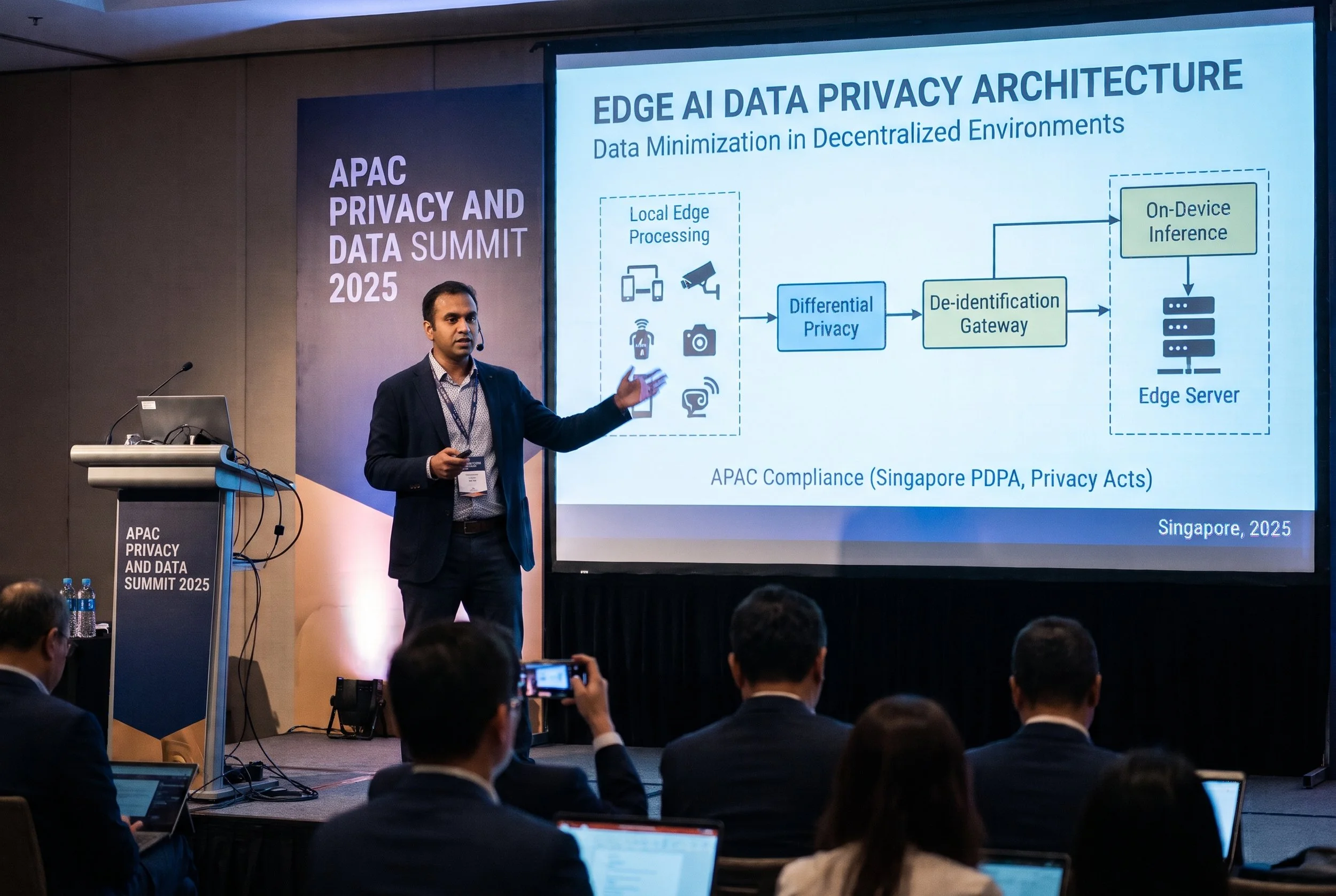
Deploying Edge AI in regulated sectors across the Asia-Pacific region demands a shift from retrospective compliance to architectural privacy-by-design. In recent keynotes at the MedTech World Roadshow (Singapore) and the India MedTech Innovation Track (New Delhi), Mohammad Ali J, Engineering Leadership, detailed how combining Trusted Execution Environments (TEEs), Federated Learning, and automated edge-native governance resolves compliance friction between Singapore’s Personal Data Protection Act (PDPA) and India’s Digital Personal Data Protection (DPDP) Act. This engineering architecture eliminates cloud telemetry exposure while preserving real-time inference on intelligent medical and industrial devices.
Why Is Edge AI Challenging Regional Privacy Regulations in Singapore and India?
Traditional AI pipelines rely on routing sensitive datasets back into centralized cloud lakes for continuous training and validation. By contrast, next-generation point-of-care medical devices and industrial computer-vision systems execute inference directly at the edge.
While edge processing minimizes operational latency, it triggers immediate regulatory friction under APAC's tightening data governance frameworks:
- Singapore (PDPA & Healthcare Cybersecurity Mandates): Requires strict purpose specification, accountable data governance, and verifiable protection for Protected Health Information (PHI). Transmitting raw diagnostic edge feeds across international borders risks violating cross-border data transfer requirements under PDPA Section 26.
- India (Digital Personal Data Protection Act - DPDP): Places stringent statutory obligations on "Data Fiduciaries," mandating verifiable consent lifecycles and steep statutory fines for data breaches. Storing or processing unencrypted telemetry, biometric indicators, or diagnostic data on local edge devices without deterministic audit trails breaches core DPDP data minimization principles.

What Are the Primary Attack Surfaces and Compliance Pitfalls at the Edge?
During the keynote, Mohammad Ali J outlined how compliance failures typically originate in physical hardware and device memory rather than high-level policy:
- Unencrypted Local Telemetry Caching: Unchecked logging of demographic data, operator IDs, or clinical telemetry to local memory partitions.
- Model Inversion & Reconstruction Attacks: Adversarial probing targeting local model endpoints to extract proprietary training data or reverse-engineer sensitive patient profiles.
- Inference Pipeline Telemetry Leaks: Unsanitized edge feeds inadvertently streaming raw runtime logs or metadata into third-party analytic platforms.
"In the era of ambient intelligence and autonomous point-of-care diagnostics, edge architecture is not merely a compute decision—it is an organization’s primary regulatory moat. Embedding governance directly into edge silicon transforms regulatory friction into sustained market velocity."
The Privacy Engineering Architecture: Privacy-by-Design at the Edge
To resolve these regulatory and technical constraints, our team demonstrated a modular privacy architecture tailored for edge deployments:
| Architectural Layer | Technical Implementation | Statutory Requirement Addressed |
|---|---|---|
| Silicon / Hardware | Hardware-Enforced TEEs (Trusted Execution Environments) creating tamper-proof memory enclaves for model weights and real-time inference. | Prevents local memory dumps; fulfills technical safeguard requirements under India's DPDP Act. |
| Decentralized Learning | Federated Edge Learning ("Move the algorithm to the data, never the data to the central cloud"). | Eliminates cross-border data export hurdles under Singapore PDPA Section 26. |
| Ingestion Gateway | Programmatic Privacy Filters applying runtime differential privacy, tokenization, and strict data-minimization policies. | Automates compliance with purpose limitation and localized data retention mandates. |
Frequently Asked Questions
Ready to Deploy Compliant Edge AI Across ASEAN?
Accelerate your MedTech or industrial AI deployments without risking non-compliance. Engage directly with Mohammad Ali J and our privacy engineering team to evaluate your hardware enclaves, federated learning nodes, and cross-border telemetry flows.