


In a decisive enforcement action under China's Personal Information Protection Law (PIPL), the Cyberspace Administration of China (CAC) has publicly notified 33 mobile applications for illegal collection and use of personal data. Spanning utilities, financial services, education, and lifestyle platforms, the targeted inspection underscores that regulators are no longer issuing passive guidance—they are enforcing strict, technical-level accountability on mobile ecosystems.
The 4 Core Compliance Violations Identified by Regulators
The official inspection exposed persistent operational gaps between stated corporate privacy policies and actual client-side code behaviors. The cited violations fall into four distinct categories:
1. Failure to Display or Properly Prompt Privacy Policies
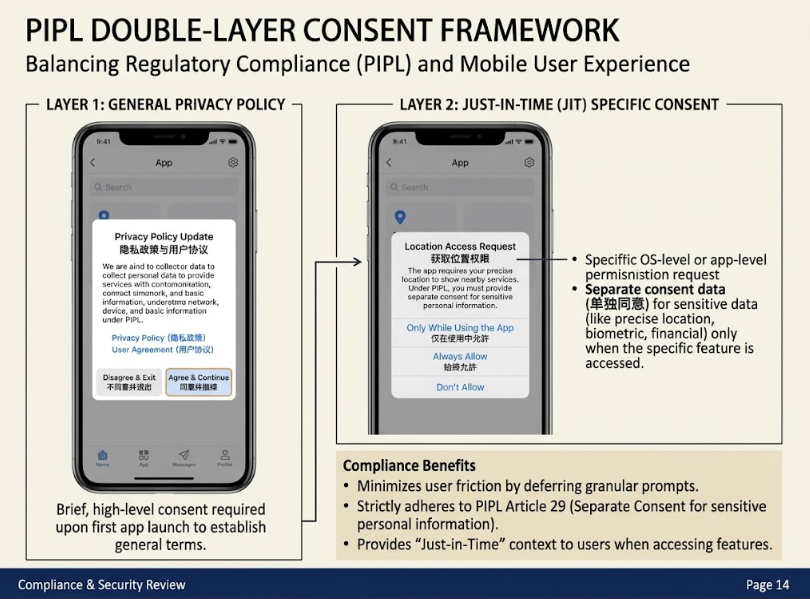
Over a dozen applications failed to present comprehensive privacy policies, or failed to clearly prompt users via prominent pop-up dialogs upon initial launch. PIPL strictly mandates that consent must be voluntary, explicit, and informed before any data ingestion begins.
2. Concealed Third-Party SDKs and Unnotified Data Sharing
Inspectors identified apps integrating third-party Software Development Kits (SDKs) that harvested user identifiers and device telemetry without explicit itemization. Under current regulatory guidelines, developers cannot hide behind aggregated disclosures; every active SDK, its specific processing purpose, and ingested data types must be individually enumerated.
3. Violation of the "Necessity Principle" (Data Minimization)
Multiple platforms collected sensitive device permissions—such as precise GPS coordinates, contact directories, and clipboard data—unrelated to the core services requested by users. Bundling non-essential permissions as a mandatory condition for basic service usage constitutes a direct breach of statutory minimization mandates.
4. Arbitrary Barriers to Account Cancellation
Regulators cracked down on applications imposing unreasonable obstacles on the statutory "right to deletion." Deficiencies included burying account cancellation buttons deep in nested settings, demanding excessive authentication proof, or failing to offer functional account deactivation channels altogether.
What This Means for Multinational App Operators
For foreign enterprises, automotive OEMs with connected infotainment systems, and multinational brands deploying localized apps in Mainland China, this enforcement wave carries severe operational implications:
- 15-Day Rectification Windows: App operators flagged by authorities face strict timelines to remediate codebases. Failure to pass verification results in nationwide app-store takedowns and operational suspension.
- Substantial Corporate & Personal Fines: Beyond takedowns, PIPL empowers regulators to impose fines up to 5% of annual turnover, alongside personal civil penalties on directly responsible executives.
- Cross-Border Telemetry Scrutiny: Applications that collect diagnostic logs or behavioral data in China and synchronize with global cloud instances (e.g., in AWS, Azure, or private servers) are under elevated regulatory surveillance for unauthorized cross-border transfers.
Enterprise Checklist: Fortifying Your App Before Inspection
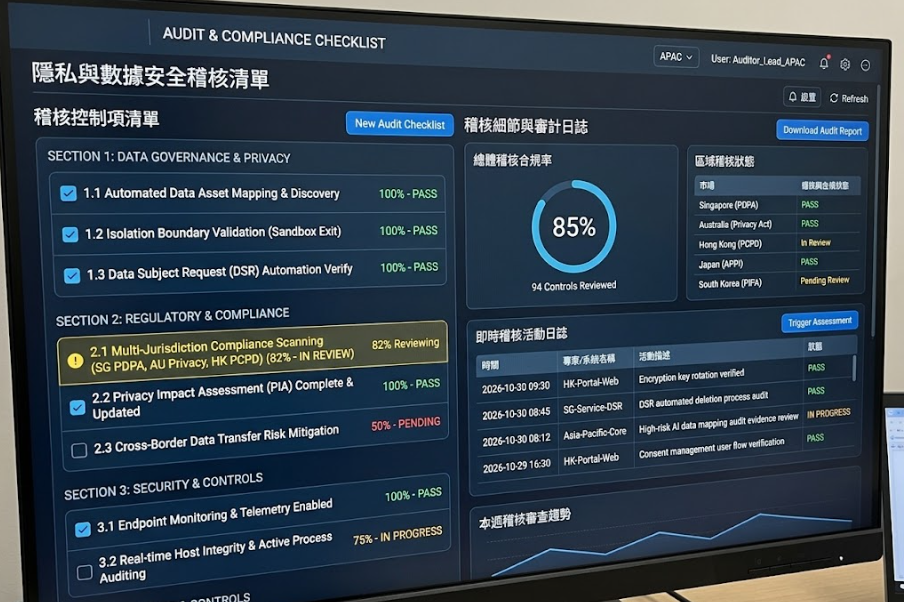
To mitigate regulatory exposure and protect enterprise reputation, engineering and legal compliance teams should immediately enact four technical safeguards:
- Execute Static and Dynamic SDK Audits: Use automated scanning tools to detect dormant or undeclared SDK telemetry calls across both iOS and Android build packages.
- Implement Frictionless Account Deletion: Ensure account deactivation can be accomplished in under four clicks, accompanied by deterministic data purges from backend production databases.
- Enforce Strict Just-In-Time Permission Prompts: Never request sensitive permissions (camera, microphone, precise location) at startup; solicit permissions only when specific features are actively triggered by the user.
- Conduct Regular Personal Information Protection Audits: Maintain detailed Privacy Impact Assessments (PIAs) validating that all collection practices adhere strictly to the principle of statutory necessity.
Audit Your Mobile Apps Against China PIPL Mandates
Are your mobile applications, connected products, or overseas cloud sync pipelines fully compliant with Chinese cyberspace regulatory standards and SDK transparency rules?
Meta Connects Asia provides end-to-end PIPL compliance audits, automated SDK privacy scanning, and Privacy Impact Assessments (PIAs) tailored for multinationals operating across Greater China and the APAC region.
On 27 April 2026, the Cyberspace Administration of China (CAC), alongside industrial and security regulators, announced a major sweep of mobile apps. After a rigorous investigation into how digital platforms handle your private info, they’ve called out 33 apps for breaking the law.
Why Were These Apps Flagged?
The investigation found that these apps weren't playing by the rules established under the Personal Information Protection Law (PIPL). Here is a breakdown of the main "red flags" discovered:
Hidden Terms: 15 apps didn't have clear privacy rules or failed to show them to users when first opened.
Secret Data Sharing: Two apps were using third-party tools (SDKs) to collect data without listing them or asking for your permission.
Data Greed: Four apps were caught collecting personal info that had absolutely nothing to do with the services they actually provide.
The "Trap" Factor: 12 apps made it nearly impossible for users to close or delete their accounts, either by hiding the option or setting unfair conditions.
What Happens Next?
The clock is ticking for these developers. The CAC has issued a strict 15-working-day deadline for these companies to fix their issues and report back.
The Bottom Line: If these apps don't clean up their act, they face further legal penalties or even being pulled from app stores entirely.
What This Means for You
This move is part of a broader 2026 initiative to ensure your digital footprint stays under your control. It’s a great reminder to:
Check your permissions: Does that flashlight app really need your location?
Review your accounts: If you aren't using an app, try to delete the account rather than just uninstalling it.
Read the pop-ups: Even though they’re tedious, those initial prompts are where apps are legally required to tell you what they're doing with your data.
How do you usually decide whether to trust a new app with your personal information?
Reference: refer to the official information - here