

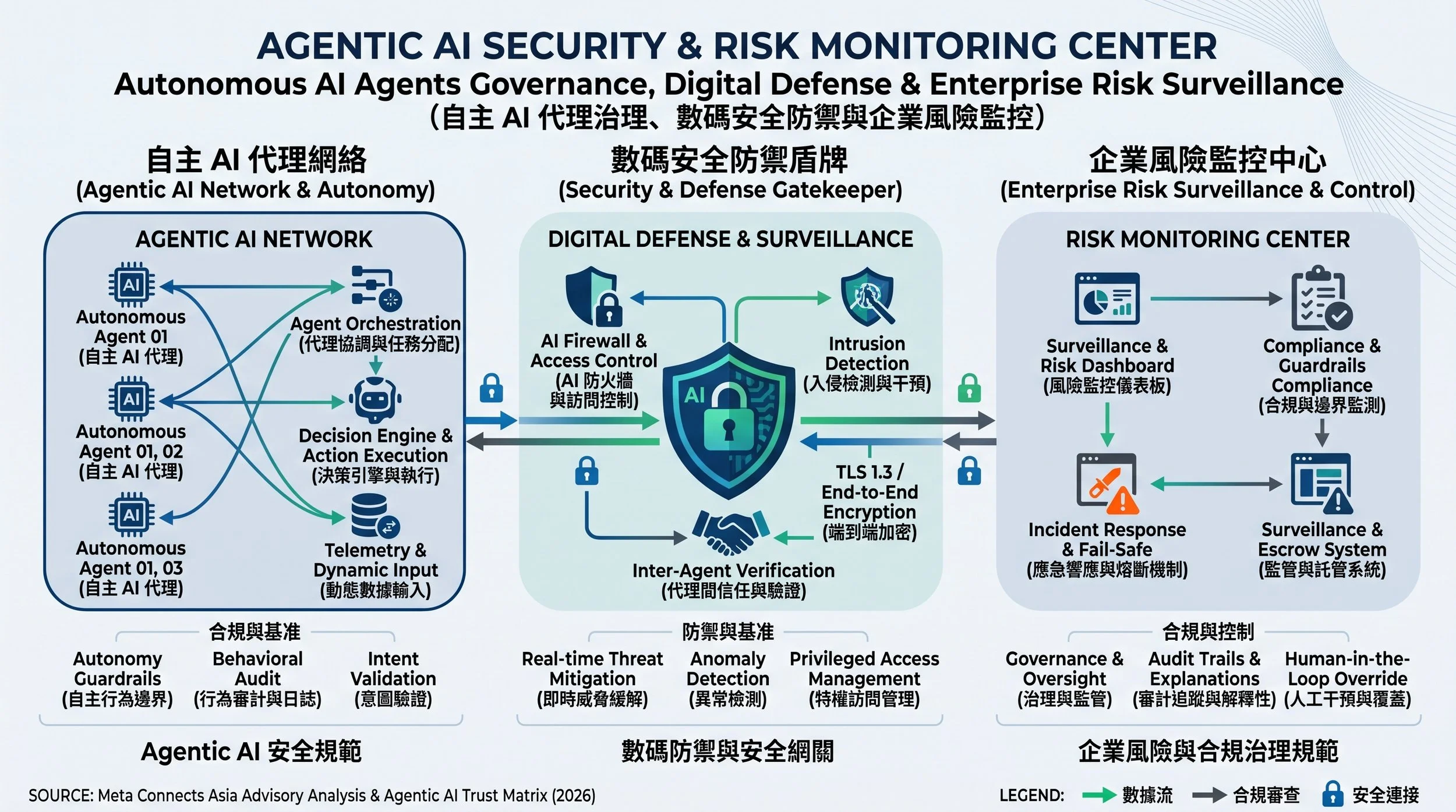
Look at the headlines from late November 2026 alone, and a troubling pattern emerges. 1Password confirmed that a hijacked employee GitHub account exposed internal source code and customer metadata. FIFA disclosed a breach involving personal and commercial records. Australian travel giant Flight Centre had to notify the market after a third-party booking system suffered unauthorized access. Closer to home in Southeast Asia, Thailand’s Securities and Exchange Commission (SEC) reported a credential-based intrusion into its electronic filing system, compromising user identities.
When incidents of this scale hit the news almost weekly, a dangerous mindset sets in across boardrooms: breach fatigue. If even cybersecurity vendors and financial regulators get hit, it is tempting to shrug off data exposure as an unavoidable cost of doing business—something a standard PR apology can smooth over.
That complacency could not come at a worse time. As businesses rush to deploy Agentic AI, security researchers are warning of a fast-moving "cyber pandemic." In an era of autonomous software, treating data protection as a minor operational issue is an existential gamble.
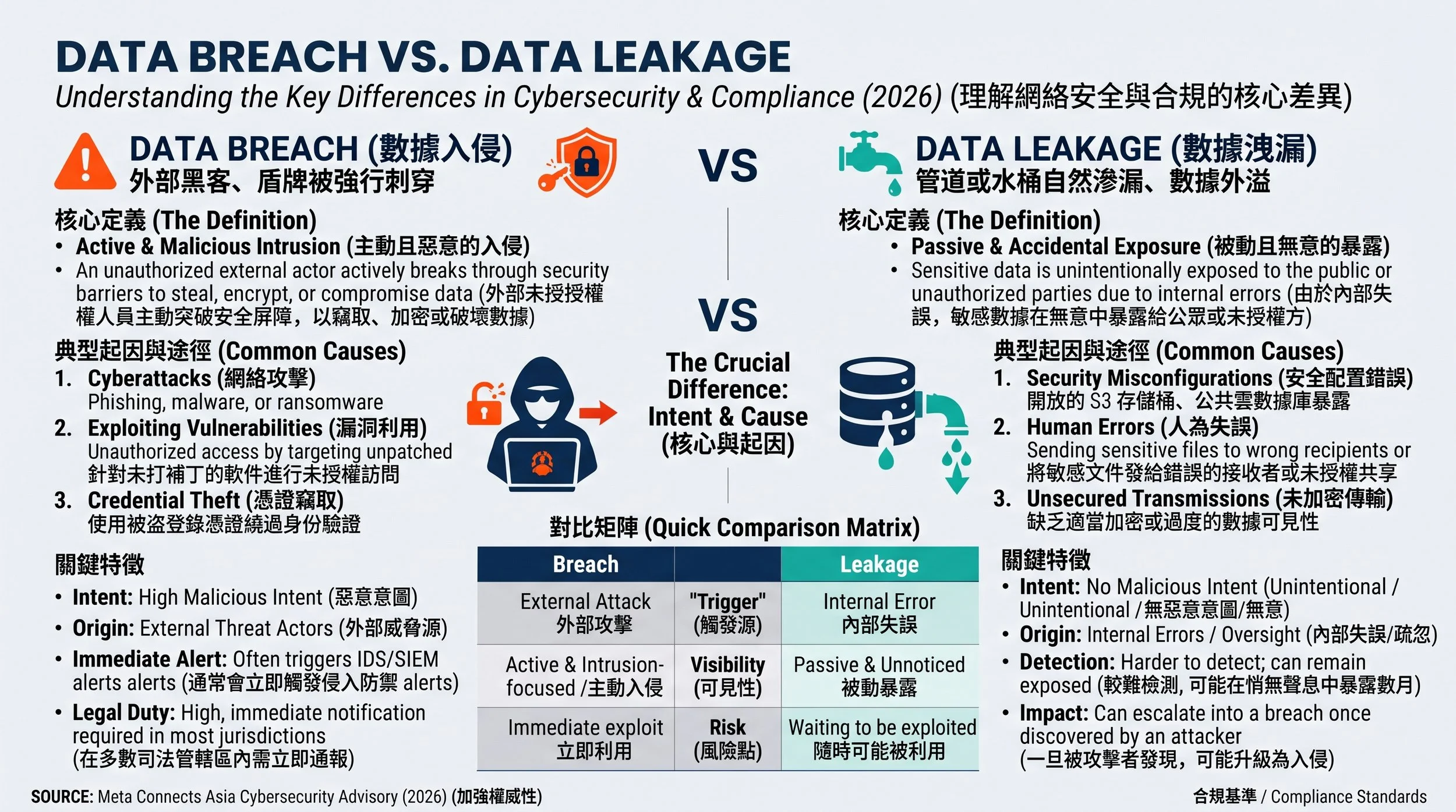
Data Breach vs. Data Leakage: Same Outcome, Different Mechanics
Before fixing the problem, leadership teams need to distinguish between how data actually leaves the building. While headlines lump everything under "data leaks," the mechanics—and the remedies—are quite different:
- Data Breach (The Break-In): An external attacker actively forces their way past your perimeter. Think of the FIFA intrusion or the Thailand SEC incident, where bad actors used stolen credentials to break into restricted databases.
- Data Leakage (The Open Door): Sensitive information slips out from the inside without an attacker necessarily "hacking" your firewall. In the 1Password case, compromising a single employee account allowed attackers to ride legitimate internal pipelines (CI/CD) to pull data out. In day-to-day operations, leakage happens when staff paste confidential files into public AI tools, misconfigure cloud permissions, or let automated workflows over-share data.
"Put simply: a breach is a thief picking your lock; leakage is leaving the keys in the ignition while the engine runs."
Why Agentic AI Changes the Risk Equation
Early generative AI tools were passive—you typed a prompt, and they wrote an answer. Agentic AI is a different beast entirely. Modern AI agents plan multi-step tasks, read internal databases, call external APIs, and execute actions across your software stack on their own.
That autonomy accelerates risk on both sides of the fence:
1. Internally: AI Agents as Unchecked "Super-Accounts"
To make an AI agent genuinely useful, companies often hand it broad access across emails, CRMs, financial folders, and code repositories—a vulnerability OWASP classifies as Excessive Agency. In effect, you have created a tireless employee with master keys to the entire company. As academic research on Indirect Prompt Injection has demonstrated, an attacker doesn't even need to hack your network anymore. By hiding invisible instructions inside an incoming resume, vendor invoice, or webpage, they can quietly hijack your AI agent into packaging up client lists and emailing them out—turning your own automation into a silent vector for data leakage.
2. Externally: Automated, Viral Attacks
Threat intelligence reports from late 2026 confirm that threat actors are now using open-source agentic frameworks to automate reconnaissance and lateral movement. Tasks that used to take a human hacking crew weeks—scanning third-party vendors like Flight Centre's suppliers, testing stolen credentials, and mapping internal networks—now happen at machine speed. When attacks propagate like a virus across interconnected supply chains, a minor lapse in one corner of your ecosystem quickly becomes a full-blown crisis.
Breach Fatigue Is Expensive: The Real Cost of Complacency
Why shouldn't businesses simply accept data exposure as the new normal? Because regulators and enterprise clients certainly haven't.
According to IBM’s Cost of a Data Breach research, the financial fallout in ASEAN has climbed past $4.12 million per incident. Across Singapore, Thailand, Indonesia, Malaysia, and Europe, enforcement under PDPA and GDPR frameworks has shifted into high gear. Regulators no longer accept "we were hacked" as an excuse; they demand proof of due diligence and strict adherence to mandatory breach notification windows (often 72 hours). Meanwhile, multinational clients are increasingly writing strict AI and data governance clauses into vendor contracts—meaning a single mishandled leak can wipe out years of commercial trust overnight.
Why Preventive Action Always Costs Less Than Corrective Firefighting
There is an old truth in operational risk: an ounce of prevention costs a fraction of a pound of cure.
Once a breach happens, a company is forced into corrective action mode. That means emergency system shutdowns, six-figure forensic retainers, regulatory audits, legal defense fees, potential fines, and months of senior leadership distracted from actual growth. It is chaotic, public, and deeply expensive.
Preventive action, by contrast, is quiet, structured, and vastly cheaper. By embedding safeguards before systems go live, businesses neutralize most threats at the source through two foundational disciplines:
- Privacy Engineering: Instead of treating privacy as a legal checklist, NIST’s Privacy Framework emphasizes building protection directly into your technical architecture. Through data anonymization, strict API scoping, and dynamic access isolation, you ensure that even if an AI agent is manipulated or an account is compromised, sensitive personal data (PII) remains unreadable and compartmentalized.
- Data Governance: AI is only as safe as the data permissions underneath it. Solid governance gives you clear visibility into what sensitive data you hold, where it sits, and exactly which human—or AI agent—is authorized to touch it.
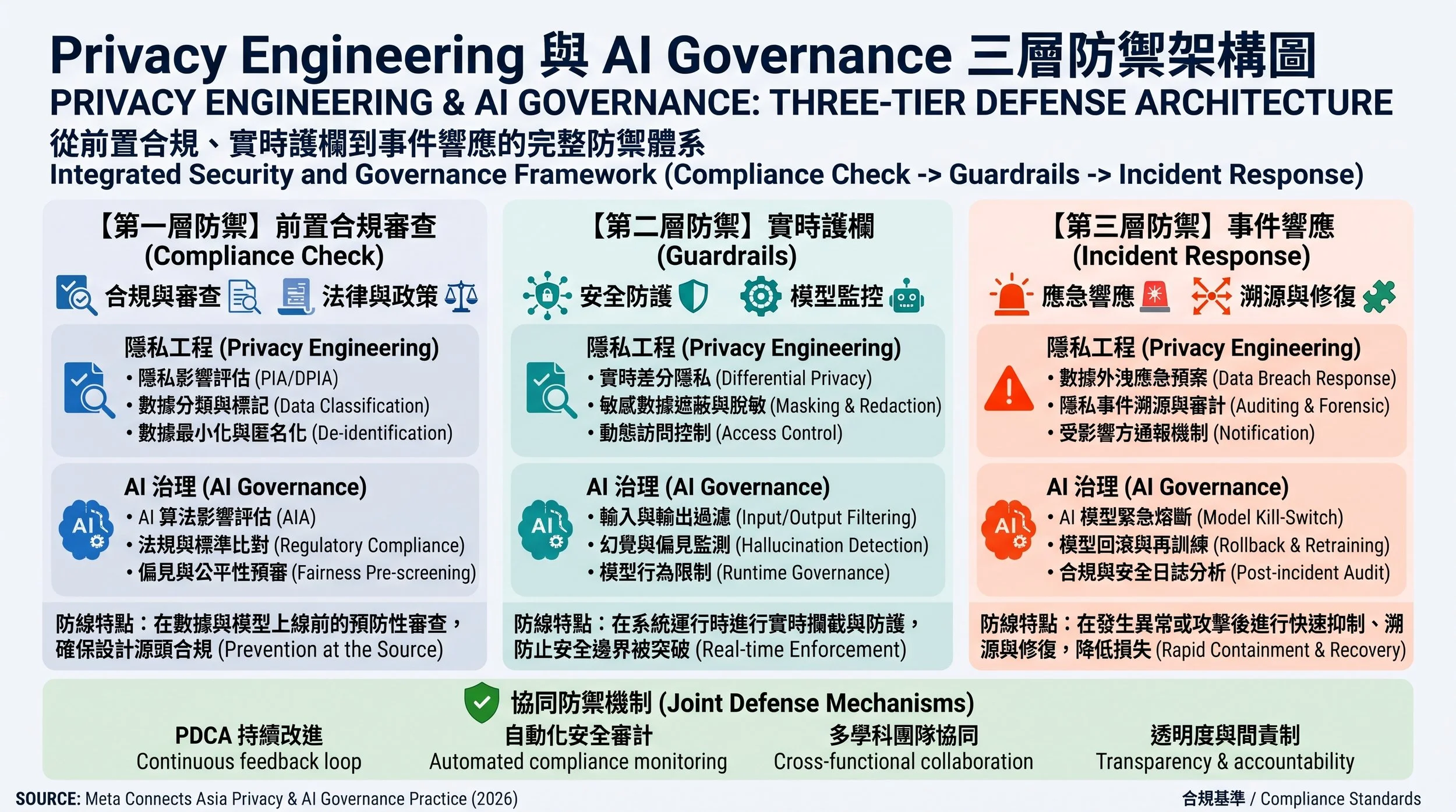
How We Help: Building a Practical Defense Before and After Trouble Strikes
You do not need to halt AI adoption to stay safe, nor do you need to overspend on bloated bureaucracy. We help organizations build a pragmatic, cost-effective shield covering both upfront prevention and crisis readiness:
1. Data Compliance Check (Finding Blind Spots Early)
We audit your data flows, cloud permissions, and third-party API integrations to uncover hidden leakage paths before bad actors do. Benchmarked against ASEAN and international privacy laws, we help you classify sensitive assets, lock down over-privileged accounts, and apply practical Privacy Engineering fixes.
2. AI Governance (Putting Guardrails on Autonomy)
Before or during your rollout of generative and Agentic AI, we design clear operational guardrails. From enforcing "least-privilege" access boundaries for AI agents to setting up mandatory Human-in-the-Loop approvals for high-stakes actions, we ensure your team captures AI productivity without handing over the keys to the vault.
3. Incident Response & Regulatory Compliance (Controlled Execution Under Pressure)
In a cyber-pandemic environment, no defense is 100% bulletproof—which makes your response playbook just as critical as your firewall. We help you build and stress-test a practical Incident Response plan so your team knows how to isolate threats and preserve forensic evidence in the critical first hours. Alongside technical containment, our advisors guide you through the legal and regulatory maze—assessing reporting obligations, drafting statutory notifications under local PDPA/privacy laws, and managing stakeholder communications so a technical hiccup doesn't escalate into a regulatory catastrophe.
Final Thought
Data leaks may be making weekly headlines, but they should never become routine inside your organization. In the age of Agentic AI, the businesses that pull ahead won't be the ones that ignore the risks—they will be the ones that invest a fraction of the effort upfront to govern their data, engineer their privacy, and prepare their response.
Ready to Pressure-Test Your Defenses Before an Incident Forces Your Hand?
Reach out to our advisory team to schedule a Data Compliance Check, AI Governance review, or Incident Response readiness session tailored to your enterprise architecture.