

Cross-Border Data Compliance in APAC: A Comparative Framework (PIPL vs. PDPA vs. PDPO vs. GDPR)
Quick Answer for Enterprise Decision-Makers
Cross-border data transfer across the Asia-Pacific (APAC) region cannot rely on a "one-size-fits-all" GDPR framework. While the European Union enforces a centralized adequacy mechanism, APAC operates under a fragmented, multi-jurisdictional regime. Organizations moving enterprise or employee data between Mainland China, Hong Kong, and Singapore must navigate distinct statutory thresholds: Mainland China's PIPL demands rigorous security assessments or standard contracts with explicit separate consent; Singapore's PDPA focuses on comparable protection and transfer limitation obligations; and Hong Kong's PDPO relies on recommended contractual clauses and cross-boundary transfer guidelines under Section 33 principles.
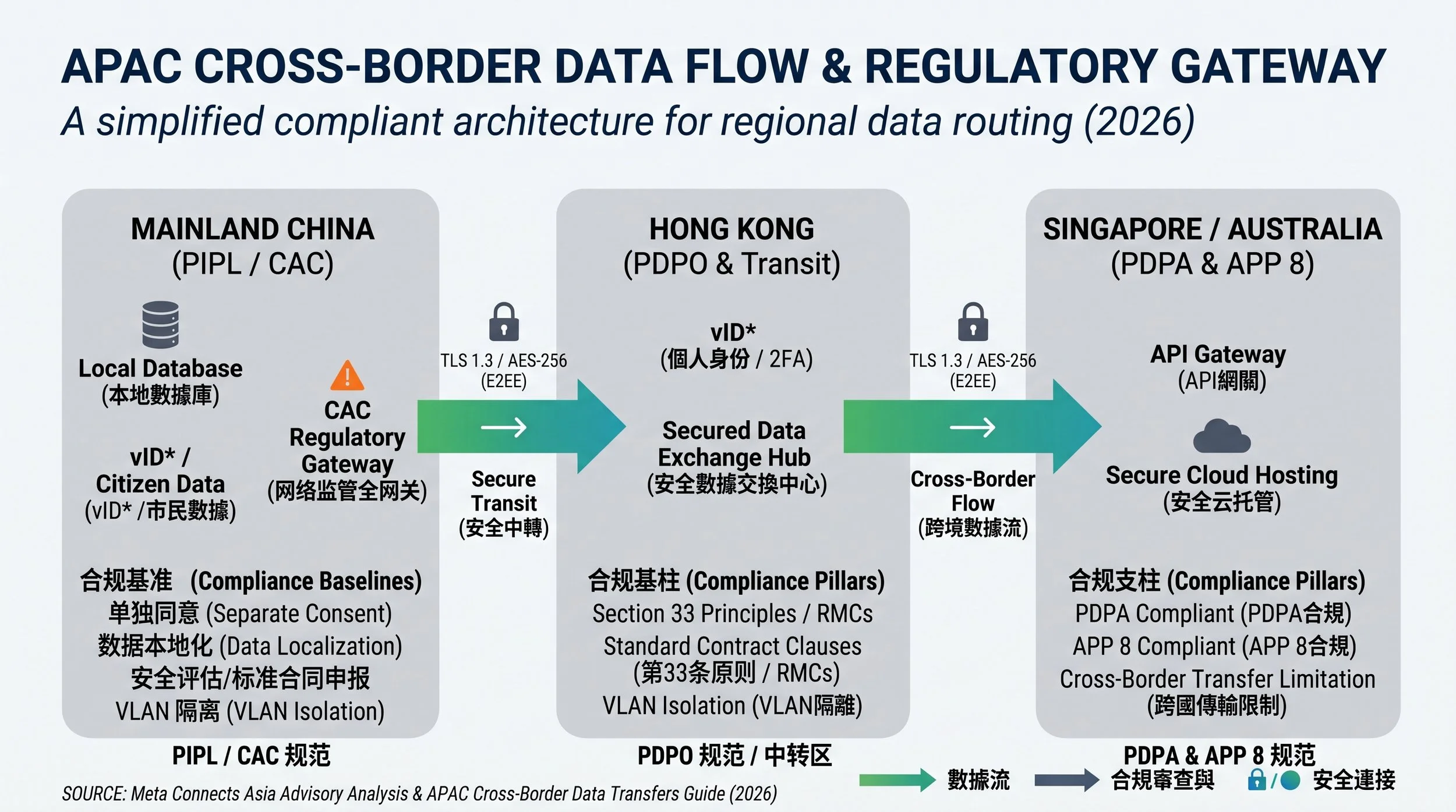
1 Regional Cross-Border Data Transfer: Comparative Matrix
The table below outlines core compliance instruments, consent thresholds, and assessment obligations across the four key regulatory frameworks governing Asia-Pacific businesses:
| Regulatory Dimension | Mainland China (PIPL) | Hong Kong SAR (PDPO) | Singapore (PDPA) | European Union (GDPR Benchmark) |
|---|---|---|---|---|
| Primary Compliance Instruments |
|
|
|
|
| Consent Requirements | Mandatory Separate Consent (Specific, informed, and strictly unbundled) | Notification of purpose at collection; explicit consent if purpose materially changes | Informed consent required unless statutory exceptions apply | Freely given, specific, informed consent or alternative legal basis (e.g., Legitimate Interest) |
| Regulatory Filing / Thresholds | Mandatory filing with CAC if reaching statutory volume or critical infrastructure thresholds | Voluntary self-regulation; no direct regulatory pre-approval mandated | No government pre-approval; self-enforced through internal compliance documentation | Prior consultation with Supervisory Authority required only for unmitigated high-risk processing (DPIA) |
| Mandatory Breach Notification | Immediate notification to authorities and affected individuals upon risk of harm | Notification strongly recommended (expected mandatory amendment standard) | Mandatory notification to PDPC within 3 calendar days (72 hours) if significant harm or scale | Mandatory notification to Supervisory Authority within 72 hours; individual notice if high risk |
| Data Subject Access Rights (DSAR) | Right to access, copy, rectify, erase, restrict, and obtain explanations | Right to access and correct personal data (within 40 calendar days) | Right to access, correct, and withdraw consent | Full rights: access, rectification, erasure ("right to be forgotten"), restriction, and data portability |
2 Practical 4-Step Cross-Border Compliance Roadmap
To operationalize these overlapping requirements across regional subsidiaries, enterprises should execute the following technical and operational workflow:
Enterprise Data Inventory & Mapping
- Identify all personal information (PI) and sensitive personal information (SPI) flowing between Sydney, Hong Kong, and Shanghai nodes.
- Classify data streams across corporate systems (HR databases, CRM platforms, ERP, and customer support channels).
- Pinpoint primary cloud hosting infrastructure locations (e.g., Microsoft 365, Azure, AWS tenant regions).
Jurisdiction-Specific Gap Analysis
- Determine whether cross-border flows from Mainland China trigger the CAC mandatory security assessment or qualify for standard contract (SCC) filing.
- Review intra-group data transfer agreements (DTAs) to verify whether Hong Kong's Recommended Model Clauses and Singapore's comparable protection requirements are incorporated.
- Validate that privacy notices present explicit and separate consent disclosures where Chinese PIPL applies.
GRC Platform & Security Tooling Orchestration
- iDataTrust / OneTrust Integration: Automate regional DSAR intake workflows, vendor risk assessments, and dynamic consent tracking tailored to local visitors.
- Microsoft Purview Configuration: Implement sensitivity labels (e.g., Confidential - Regional Transfer Restricted), enforce DLP policies to prevent unauthorized bulk export, and configure automated retention.
Incident Response & Scenario Training
- Establish unified incident management runbooks accounting for differential statutory notification clocks (72-hour limits in Singapore/Europe vs. immediate notification protocols under PIPL).
- Conduct role-based, scenario-driven training workshops for cross-border governance, security, HR, and cloud engineering teams.
3 Frequently Asked Questions (FAQ)
Key operational answers addressing multi-jurisdiction compliance challenges across APAC:
Can global enterprises use a single standard GDPR contract to authorize data transfers in APAC?
No. While GDPR contracts provide a strong baseline, they do not satisfy local statutory requirements. Mainland China’s PIPL requires the exact, unaltered CAC Standard Contract and unbundled separate consent. Singapore’s PDPA mandates specific assurances of comparable protection. Organizations must implement a master intra-group agreement supplemented by jurisdiction-specific regional addenda.
What is the biggest pitfall when deploying GRC software like iDataTrust or OneTrust for cross-border teams?
The primary failure point is treating GRC software as an off-the-shelf IT deployment without prior data classification. If an enterprise does not thoroughly map data flows and understand local retention obligations beforehand, automated discovery modules and DSAR workflows will generate false classifications and fail regulatory scrutiny.
How do recent data cross-border facilitation policies between Mainland China and Hong Kong affect multinational corporations?
Initiatives such as the Standard Contract for Cross-Boundary Data Flows within the Guangdong-Hong Kong-Macao Greater Bay Area (GBA) streamline transfers between specific entities, but strict eligibility criteria, filing requirements, and security commitments remain applicable. Enterprises must verify whether their cross-border operations fall strictly within designated GBA provisions.
Regulatory & Informational Disclaimer: The information provided in this guide is for educational, general informational, and operational governance purposes only. Meta Connects Asia is an independent data privacy, GRC, and technical advisory consultancy and does not provide legal advice, legal opinions, or formal statutory legal representation. Reading this material or scheduling an advisory briefing does not create a lawyer-client relationship. Cross-border regulatory frameworks (including PIPL, PDPA, PDPO, and GDPR) are subject to dynamic statutory updates and judicial interpretation; organizations should consult qualified legal counsel in the relevant jurisdictions for formal legal opinions on specific compliance obligations.
Need Support with Cross-Border Data Architecture?
Meta Connects Asia specializes in pragmatic data privacy advisory, regulatory mapping (PIPL / PDPA / PDPO / GDPR), and enterprise GRC tool implementation across Sydney, Hong Kong, and Shanghai.